
The Research Bottleneck AI Is Breaking Open
Over 5 million academic papers are published every year. No human team can read them all, let alone synthesize them into coherent hypotheses and then run the experiments to test those hypotheses. That gap between the pace of publication and the capacity for synthesis has been widening for decades. In 2026, a cluster of AI systems is starting to close it — not by replacing researchers, but by automating the most time-consuming steps between idea and result.
The pipeline has three distinct stages: literature review, hypothesis generation, and experimental execution. Until recently, AI tools addressed each in isolation. What’s changed is that these stages are starting to connect — and in a small number of labs, the entire chain is running without human intervention at every step.
Stage 1: Literature Review — From Weeks to Hours
Elicit remains the clearest example of production-ready AI for literature review. The tool searches across 138 million academic papers and 545,000 clinical trials, extracts data into structured matrices, and returns results in seconds rather than weeks. Independent evaluations put its extraction accuracy between 94% and 99.4% — a 2025 VDI/VDE case study found Elicit correctly extracted 1,502 out of 1,511 data points. Researchers report up to 80% time savings on systematic reviews.
These numbers matter because systematic reviews are the bedrock of evidence-based science: clinical medicine, public health policy, materials science. When a systematic review takes six months and a team of five, many questions simply don’t get asked. When it takes two weeks and two people, the calculus changes.
A 2025 PMC validation study found that AI-assisted screening correctly identifies 95% of relevant papers, with data extraction accuracy above 90%. The gap with human reviewers — who average around 86.7% accuracy in the same studies — is narrowing to statistical insignificance. That’s not a reason to remove humans from the loop; it’s a reason to let them focus on interpretation rather than extraction.
Stage 2: Hypothesis Generation — AI Proposing What to Test
Moving past literature synthesis into hypothesis generation is harder. This is where most systems still require significant human direction. But the boundary is shifting.
Sakana AI’s AI Scientist — published in Nature in March 2026 — is the clearest evidence of what’s now possible. The system generates novel research ideas by treating existing literature as a mutation space: it proposes variations and extensions of known work, checks each idea against the Semantic Scholar API to filter out near-duplicates, then selects candidates by predicted novelty and feasibility. It is not choosing randomly. It is doing something closer to structured search across an idea space too large for any individual researcher to explore manually.
The Sakana system then writes the experimental code, runs the experiments using parallelized agentic tree search, analyzes the results, generates figures, and produces a complete LaTeX manuscript. One unedited, fully AI-generated paper submitted to the ICLR 2025 ICBINB workshop received an average peer review score of 6.33 — above the human acceptance threshold. The system is open source.
This is not a demonstration of AI writing plausible-sounding research. It is a demonstration of AI producing work that passes the same evaluation process applied to human-authored papers. The difference matters.
Stage 3: Autonomous Experimentation — The Robotic Loop
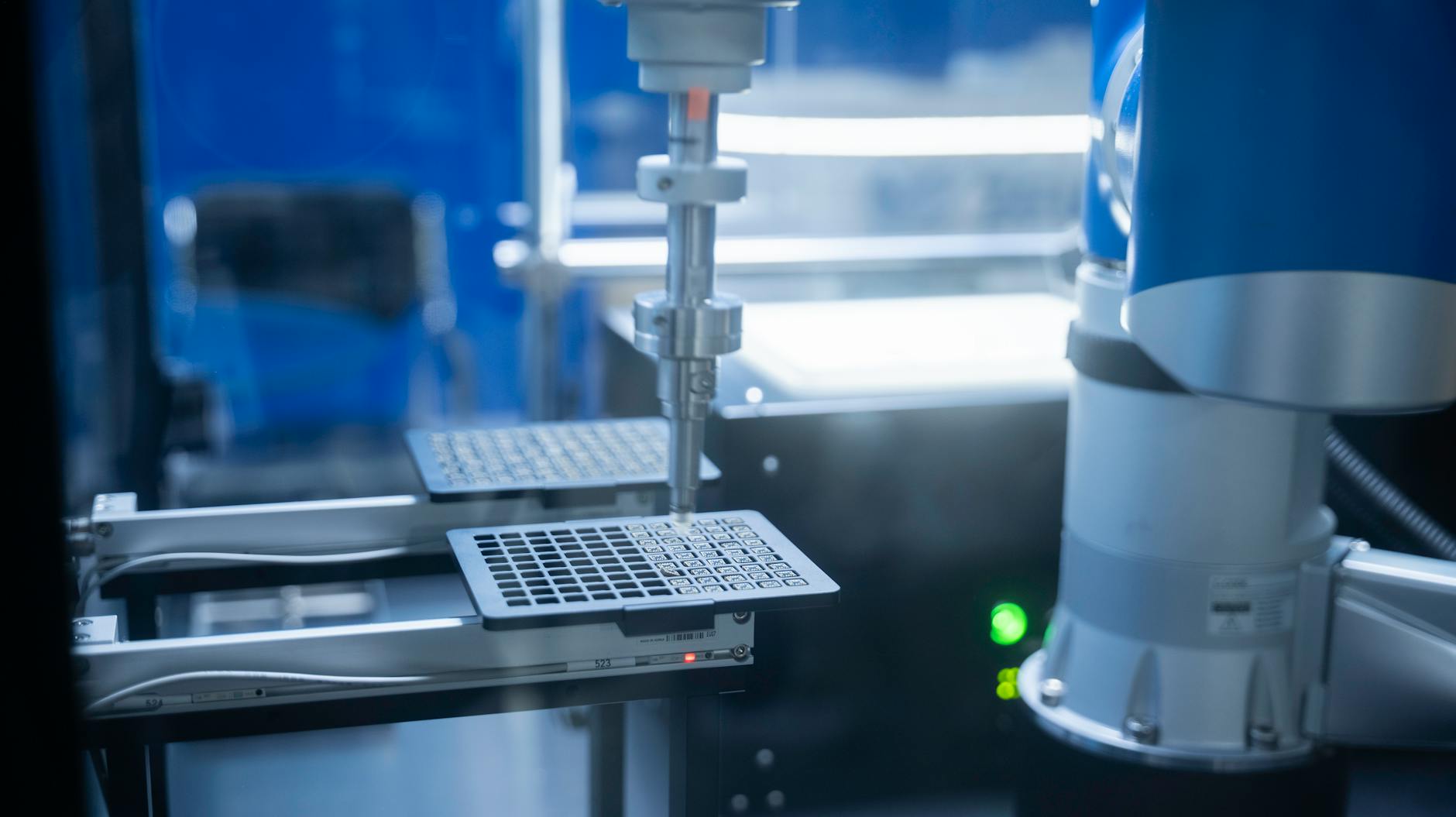
The third stage — physical experimentation — is where Berkeley Lab’s A-Lab comes in. The autonomous platform combines robotics, machine learning, and active learning to propose, synthesize, and characterize new inorganic materials in a closed loop. No human needs to be present for the A-Lab to run its next experiment: the AI proposes a compound, the robots synthesize and test it, and the results feed back into the model to guide the next proposal.
A-Lab processes 50 to 100 times as many samples daily as a comparable human team. The system runs around the clock. Researchers who previously spent most of their time executing synthesis steps now spend that time on higher-level experiment design — which is where scientific intuition actually adds value.
Berkeley Lab’s newer OPAL project extends this to biotechnology: integrating robotic systems, AI agents, and standardized data-sharing platforms to accelerate the pipeline from gene discovery to commercialized technology. The foundation models being developed there are designed to interface directly with automated lab tools, reducing experiments that would take months to days.
Where the Chain Breaks — and Why It Still Matters
These three stages — review, hypothesis, experiment — are increasingly linked, but the integration is uneven. Elicit is mature and used daily by thousands of researchers. The AI Scientist is a research artifact: impressive, open source, and not yet integrated into routine lab workflows. A-Lab is real infrastructure, but it operates in a narrow domain (inorganic materials synthesis) with well-characterized experimental steps.
The harder problem is generalization. Most scientific domains involve experimental setups that can’t be reduced to the structured loops that A-Lab handles. Biology, clinical research, and social science involve far more variability, ethical constraints, and irreducible human judgment. The AI research pipeline, for now, works best where the experimental space is well-defined and the measurement process is automatable.
There’s also a reproducibility question. If AI systems generate and evaluate their own hypotheses, who catches the errors? Sakana’s AI Reviewer — which ensembles five independent AI reviews — is one answer, but it’s not yet a substitute for the broader peer review ecosystem. The ICML cheating scandal (497 papers flagged in 2026 for AI-generated reviews violating policy) is a reminder that introducing AI into the review process creates new failure modes alongside the efficiency gains.
None of this diminishes what’s happening. The research pipeline is being restructured — not replaced. The labs that figure out how to combine these tools thoughtfully, keeping humans where judgment is genuinely needed, are likely to be significantly more productive than those that don’t. The question isn’t whether AI changes how research gets done. It’s how fast that change compounds.
Further Reading
- Sakana AI: The AI Scientist published in Nature (2026) — The official writeup of the system, including open-source links and the methodology behind its peer-review pass.
- Berkeley Lab: How AI and Automation Are Speeding Up Science — An accessible overview of A-Lab and the OPAL project, with specifics on throughput and what researchers actually do differently now.
- Elicit: How We Evaluated Systematic Review — Elicit’s own methodology documentation, worth reading for any researcher considering it for evidence synthesis work.