What the Siemens-NVIDIA Partnership Actually Builds
In January 2026 at CES, Siemens and NVIDIA announced they are building what they call an Industrial AI Operating System — a software-and-infrastructure layer designed to embed AI across the entire manufacturing lifecycle, from product design through factory operations and supply chain. The first real-world test site is the Siemens Electronics Factory in Erlangen, Germany, slated to become the world’s first fully AI-driven adaptive manufacturing site in 2026.
This isn’t a product launch announcement with a press release and vague promises. It’s a multi-year engineering commitment between two of the largest industrial and compute players in the world, and the Erlangen factory is their proof of concept.
The “AI Brain”: How the Factory Thinks
The technical core of the system is what Siemens and NVIDIA call the factory’s AI Brain. The setup works like this: every machine, process, and output on the factory floor is modeled in a live digital twin — a photorealistic, physics-accurate virtual replica built on NVIDIA Omniverse libraries and populated with operational data from Siemens’ industrial software stack.
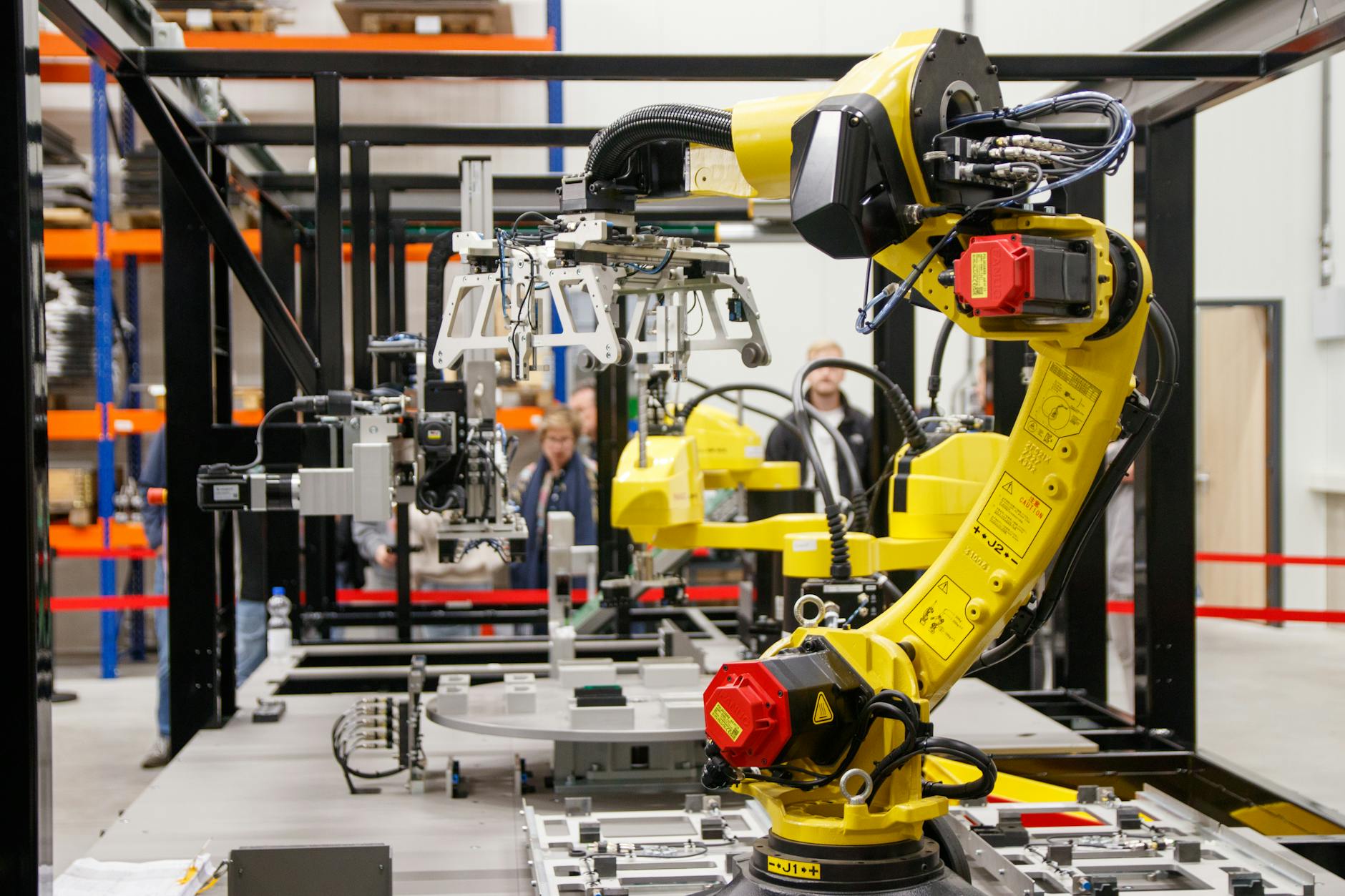
The AI Brain runs continuous simulations inside that twin. It tests proposed changes — a new robot path, a different sequencing order, a shift in quality thresholds — virtually, before touching anything physical. When a change clears validation in simulation, it gets pushed to the actual floor. The result is a factory that can self-optimize in near-real-time without production downtime for trial-and-error.
Supporting this loop is Siemens’ new Digital Twin Composer, which combines 2D and 3D factory data from Siemens’ software suite with real-time sensor input into a managed, GPU-rendered scene. Engineers and operators work from this unified view rather than juggling disconnected monitoring dashboards.
What NVIDIA and Siemens Each Bring
The partnership is a genuine stack split, not a branding arrangement. NVIDIA provides the compute substrate: GPU-accelerated infrastructure, CUDA-X libraries, NVIDIA PhysicsNeMo for physics simulation, and Omniverse for the 3D digital twin rendering engine. Siemens brings the industrial domain layer: its Xcelerator platform, factory automation hardware, operational technology (OT) software, and hundreds of dedicated industrial AI engineers.
One concrete engineering deliverable from the partnership: NVIDIA CUDA-X libraries and GPU acceleration are being integrated across Siemens’ EDA (electronic design automation) portfolio, targeting 2–10x speedups in chip verification, layout, and process optimization workflows. That matters because Siemens is also a supplier to semiconductor fabs — so the AI OS ambition reaches upstream of the factory floor into the design of what gets manufactured there.
Workers Are in the Frame, Not Out of It
A common concern with fully AI-driven factory announcements is the displacement question. The Siemens-NVIDIA approach explicitly addresses this — whether you find the answer satisfying depends on your skepticism level.
Siemens is deploying AI copilots across design, manufacturing, and operations roles. One notable detail: the company is integrating industrial AI guidance into Meta Ray-Ban AI Glasses for floor workers, enabling hands-free real-time instructions, safety alerts, and process guidance on the job. The pitch is augmentation, not replacement.
On workforce development, Siemens announced a program targeting 200,000 electricians and manufacturing specialists trained by 2030, through partnerships with academic institutions and training organizations. These numbers are significant, but training commitments from large manufacturers need to be tracked against actual hiring and retention data — not just announced targets.
The Broader Industrial AI Race
Siemens and NVIDIA are not alone in this space. As we covered in our March analysis of NTT DATA and NVIDIA’s enterprise AI factory rollout, the race to build production-grade industrial AI infrastructure has accelerated sharply in 2026. NTT DATA’s approach targets enterprise clients with a managed AI factory model — full-stack, domain-specific, with governance built in. Siemens’ Erlangen blueprint is more vertically integrated: one company owning both the factory being optimized and the AI OS doing the optimizing.
Samsung is pursuing a similar model for its semiconductor fabs. The common thread across all these initiatives is the same architectural bet: that the value of industrial AI comes not from isolated models solving individual problems, but from a persistent, real-time feedback loop between the physical factory and a continuously-updated digital representation of it.
What the Erlangen Launch Will Actually Prove
The Erlangen factory will be the first rigorous test of whether this architecture holds up under real production conditions. The claims are significant: continuous self-optimization, AI-driven scheduling and quality control, reduced commissioning time for new production lines. A global automotive supplier working with NTT DATA reported cutting production setup time from months to days using a similar GPU-accelerated factory simulation approach — that’s the benchmark the Erlangen site will be measured against.
The harder question is whether the digital twin stays accurate over time. Factory floors are messy: machines wear down, operators improvise, supply interruptions create workarounds. A digital twin that drifts from physical reality doesn’t just fail to optimize — it can actively mislead the AI Brain into recommending changes based on a state that no longer exists. Keeping the twin synchronized at the required fidelity is an unsolved operational challenge at scale.
The Erlangen launch, expected sometime in 2026, will be worth watching closely. If the AI Brain delivers measurable throughput gains and the digital twin stays accurate across a sustained production run, this architecture could become the template for industrial AI deployment globally. If it struggles with the synchronization problem or generates AI recommendations that operators distrust and ignore, it will illustrate the gap between simulation-validated and production-proven AI in manufacturing. Either outcome is instructive.
Further Reading
- NVIDIA Newsroom: Siemens and NVIDIA Expand Partnership — the official announcement with technical details on the Omniverse and CUDA-X integration.
- Siemens Press Release: Industrial AI Operating System — Siemens’ framing of the partnership, including the Digital Twin Composer and workforce development commitments.
- Interesting Engineering: Siemens, NVIDIA outline roadmap for AI-driven factories — a solid technical explainer of the CES 2026 announcement and what the roadmap involves.